Republican Politics, Irish Style
Published May 17th in Metro Eireann By Charles Laffiteau
In my first very first column for Metro Eireann, I said that while I was here in Dublin “I hope to familiarise myself with the political landscape of Ireland.” Having lived here in Dublin, Ireland since last September, now that it is Election Day in the Republic of Ireland I guess it’s time for me to share an American Republican’s perspective on Irish politics.
But before I discuss Ireland’s political parties and my views about their electoral prospects, I want to weigh in with some opinions on the mechanics of the voting process itself. For starters, I think it is much more difficult to exercise your right to vote here in Ireland than it is back in the States.
What gives with this Irish voting procedure that only gives you 2 days to cast absentee ballots? US citizens, within and outside the US can cast absentee ballots by mail for 30 days prior to Election Day, which for all national elections every 2 years is on the first Tuesday following the first Monday in November.
For reasons of both convenience and cost, the vast majority of state elections are also held that same day in conjunction with the national elections for Congress and (every four years) for the US Presidency. Furthermore, many states (including my home state of Texas) allow voters to visit designated polling places and cast their votes in person during that same 30 day window prior to Election Day.
One of the main reasons for allowing these early voting dates (including Saturdays) and absentee ballot procedures is to encourage more citizens to vote in local, state and national elections. Many states refer to them as “no excuses” voting measures in recognition of US citizens’ explanations for why they don’t vote more often, if at all.
In spite of these as well as other steps to make voter registration easier, in the last national election only 55% of eligible Americans bothered to vote. As dismal as this number is, the percentage drops to around 40-45 % in state and local elections if there isn’t a national election being held simultaneously. Worse yet, local elections for Mayor or city councils may draw as few as 20% of eligible voters to the polls.
The reason I am dwelling on this issue is because I see Ireland following this same path as the US, in terms of declining voter turnout over the last 30 years, from almost 78% in 1970 to under 63% in 2002. What I don’t see are steps by the government to address this issue. Calling for a national election on the Thursday before a bank holiday doesn’t strike me as a tactic designed to encourage voter turnout. In fact if I may be so bold as to make a prediction, I think participation in this year’s national election will probably drop below 60%.
On the other hand, I do like the fact that Ireland allows non-Irish citizens the right to vote in local elections. On this point, the US still has a long way to go, since only US citizens can vote in any local, state or national elections. Many US states go even further and do not allow US citizens who have been convicted of a felony to vote either. I find it shameful that while Ireland may one day allow its non-Irish residents the right to also vote in Dail and national elections, the US still won’t allow all of its own citizens this same privilege
I am also aware that Thursdays are the traditional election days here in Ireland much like the first Tuesday after the first Monday in November is back in the states. But I find it ironic that this same government justified its decision to schedule Ireland’s first ever nation-wide Saturday election in 2002 in order to facilitate voting by students and younger workers in Dublin in a second vote on an EU treaty.
The government said it wanted to give them time to travel to their homes outside of Dublin and vote on a EU treaty. It must have worked since voter turnout was 50% higher in the second election, but apparently Bertie doesn’t feel as strongly about them voting in Ireland’s first national election in 5 years. I wonder why?
Could it be that the government was aware that those students and workers living in Dublin were more likely to vote in favour of this EU Treaty, (which the government was backing), than other voters in rural and western Ireland who had not experienced the same benefits of EU membership? Hmmm, I think it could be.
Is it possible that this same government is also aware that those students and young workers in Dublin do not remember the bad economic times, which makes them more sympathetic to charges that the current government has been wasteful and slow in improving health services and thus more likely to vote in favour of changing the governing coalition? Hmmm, this appears to be quite plausible to me as well.
What I can tell you with a high degree of certainty, is that my own Republican Party in the US, is very wary of high voter turnout in urban areas. Why? Because students and younger workers in urban areas tend to vote for the opposing Democratic Party in addition to the Democrat’s historic constituency of organized labour, lower income minorities and the urban poor.
Up until the 1970’s Democrats also received a majority of the lower to middle income working class votes as well. But that traditional Democratic constituency started to vote Republican in the southern and western parts of the US when Nixon was elected and has been solidly Republican ever since Regan was elected in 1980.
Republicans currently rely on older, middle and upper income constituents who live in suburban and rural areas as well as the working class voters in the western and southern states for most of their voting support. Since a higher percentage of older voters tend to go to the polls than younger and or minority voters, a low voter turnout also gives the Republicans and their constituents an edge in close elections.
Next week I will discuss my perspective on Ireland’s political parties and coalitions in what looks to be a very close and tightly contested national election.
Thursday, May 17, 2007


US Ambassador Foley discusses Bush's climate change policies
Republican Politics, American Style
Published May 10th in Metro Eireann By Charles Laffiteau
US Ambassador Thomas Foley began his talk at Dublin City University (DCU) by telling the audience what he hoped to accomplish with this appearance. He started out by trying to frame the issue in terms of where the US stood relative to other countries in Europe as regards energy consumption and reducing carbon emissions as suggested in the Kyoto Protocol.
The Ambassador was on pretty firm ground here and some of the facts he referenced may have come as a surprise to some audience members. He got the bad news out of the way early by acknowledging that the US was indeed the world’s biggest polluter in terms of generating green house gases. He duly noted statistics which for example show that on a per person basis, the US generated more than 2 times as much carbon based wastes as the average German, 3 times more than the French and 40% more than the average Irish resident. From this point on, the Ambassador moved into a defensive justification or attack mode.
He said that while the US was the largest polluter in terms of total carbon wastes generated by a single country, it would be overtaken this year by China. While I think this comment was a bit of a stretch since this won’t actually happen until 2009, I will nonetheless concede this point. But the Ambassador also failed to mention that China has over one billion more citizens than the US, which means the Chinese will still only be generating 25% of the carbon wastes that are generated by the average American once it does become the world’s biggest polluting nation.
Ambassador Foley then went on to defend the US decision not to sign the Kyoto Protocol because it assigned mandatory emission limits for the reduction of greenhouse gas emissions to each signatory nation. He said that the 30% cuts in carbon emissions demanded of the US would have caused serious economic problems had the US agreed to these limitations. Mr. Foley then noted that Australia, which like the US relies on coal to generate much of its electricity, had also declined to sign the Kyoto Protocol. Ambassador Foley went on to say that the US wanted to ensure that carbon gas emission limits were also applied to countries such as China, which is not required to cut emissions under the current treaty. I must agree with him on this issue.
The Ambassador then pointed out that even though the US had not agreed to the limits, it had nonetheless done a better job of cutting the rate of growth in its carbon gas emissions than the EU countries which had signed the Kyoto Protocol. It may have come as a bit of a surprise to some in the audience that the US had cut this rate of growth to a level that was 40% less than the the EU average. But he also failed to mention that it is much easier to cut one’s rate of growth when you are already generating wastes at a much higher level than nations you are comparing yourself to.
President Bush’s strategy to tackle global warming basically relies on scientific developments and voluntary measures, rather than curbs on greenhouse-gas emissions.As part of his sales pitch to pesuade the audience that the Bush administration is seriously doing something to address the problem of global warming, Ambassador Foley outlined three methods being used to cut US green house gas emissions followed by an assessment of each method’s impact
First he mentioned greater energy efficiency being derived from the use of low wattage flourescent light bulbs and better home insulation. He then noted that even if this method was broadly utilized it would, at best, result in a 20-30% increase in energy efficiency which would be equivalent to the growth of energy consumption.
Secondly, he referred to the use of alternative sources of energy such as wind, hydro, solar and nuclear. He mentioned France as a country which emits less green house gases per person, largely because it derives 70% of its electricity from nuclear energy. The Ambassador then stated that while the US obtains about 18% of its electricity from such sources currently, their contribution was likely to drop in the near future due to the long lead times involved in bringing these types of power generation on line. In fact it has been almost thirty years since the US ordered its last nuclear plant, due to the US public’s fears about nuclear accidents after the near meltdown at Three Mile Island and the subsequent release of the anti-nuclear plant movie “The China Syndrome”.
Finally, the Ambassador alluded to the recapture of carbon emissions and sequestration of green house gases through the use of rapid reforestration, which involves planting new forests of trees on land which is no longer being used for agriculture. The impact of this program is hard to quantify, but suffice to say it is not going to result in major reductions in green house gas emissions.
By outlining all of the available “voluntary” measures for reducing green house gas emissions, Ambassador Foley had thus set the stage for what President Bush touts as the ultimate solution, new technologies. The Ambassador cited the need for technological breakthroughs in the development of fuel cells and nuclear fusion as sources of clean energy which could then be used to replace carbon based energy sources. But to realize this goal entails continuing to grow economically so that money can be generated to invest in these new technology solutions.
Noticeably absent from Ambassador Foley’s discussion of President Bush’s proposals to reduce green house gases are federal government regulations to increase automobile fuel economy standards and reduce carbon dioxide emissions. The Ambassador noted that individual states like California had always led the way in this area and that the US government would follow once a consensus had emerged at the state level. However, as I mentioned in my previous column, the US Supreme Court recently chastized Bush appointees at the EPA for refusing to regulate automobile emissions of green house gases as mandated by existing federal laws.
Nor was any mention made of a separate and unanimous Supreme Court ruling which said that the EPA also had authority over factories and power plants that add generating capacity or make renovations that increase emissions of air pollutants. One must therefore conclude that the Bush administration’s refusal to uphold existing federal laws governing green house gas emissions by automobiles and power plants is seriously at odds with the Ambassador’s contention that President Bush is very concerned about this problem and is actively working to address it.
While I believe the US Ambassador was being sincere and honest in discussing what he believes the Bush administration is doing to address climate change, the actions of the Bush administration thus far speak much louder than Ambassador Foley’s words.
Published May 10th in Metro Eireann By Charles Laffiteau
US Ambassador Thomas Foley began his talk at Dublin City University (DCU) by telling the audience what he hoped to accomplish with this appearance. He started out by trying to frame the issue in terms of where the US stood relative to other countries in Europe as regards energy consumption and reducing carbon emissions as suggested in the Kyoto Protocol.
The Ambassador was on pretty firm ground here and some of the facts he referenced may have come as a surprise to some audience members. He got the bad news out of the way early by acknowledging that the US was indeed the world’s biggest polluter in terms of generating green house gases. He duly noted statistics which for example show that on a per person basis, the US generated more than 2 times as much carbon based wastes as the average German, 3 times more than the French and 40% more than the average Irish resident. From this point on, the Ambassador moved into a defensive justification or attack mode.
He said that while the US was the largest polluter in terms of total carbon wastes generated by a single country, it would be overtaken this year by China. While I think this comment was a bit of a stretch since this won’t actually happen until 2009, I will nonetheless concede this point. But the Ambassador also failed to mention that China has over one billion more citizens than the US, which means the Chinese will still only be generating 25% of the carbon wastes that are generated by the average American once it does become the world’s biggest polluting nation.
Ambassador Foley then went on to defend the US decision not to sign the Kyoto Protocol because it assigned mandatory emission limits for the reduction of greenhouse gas emissions to each signatory nation. He said that the 30% cuts in carbon emissions demanded of the US would have caused serious economic problems had the US agreed to these limitations. Mr. Foley then noted that Australia, which like the US relies on coal to generate much of its electricity, had also declined to sign the Kyoto Protocol. Ambassador Foley went on to say that the US wanted to ensure that carbon gas emission limits were also applied to countries such as China, which is not required to cut emissions under the current treaty. I must agree with him on this issue.
The Ambassador then pointed out that even though the US had not agreed to the limits, it had nonetheless done a better job of cutting the rate of growth in its carbon gas emissions than the EU countries which had signed the Kyoto Protocol. It may have come as a bit of a surprise to some in the audience that the US had cut this rate of growth to a level that was 40% less than the the EU average. But he also failed to mention that it is much easier to cut one’s rate of growth when you are already generating wastes at a much higher level than nations you are comparing yourself to.
President Bush’s strategy to tackle global warming basically relies on scientific developments and voluntary measures, rather than curbs on greenhouse-gas emissions.As part of his sales pitch to pesuade the audience that the Bush administration is seriously doing something to address the problem of global warming, Ambassador Foley outlined three methods being used to cut US green house gas emissions followed by an assessment of each method’s impact
First he mentioned greater energy efficiency being derived from the use of low wattage flourescent light bulbs and better home insulation. He then noted that even if this method was broadly utilized it would, at best, result in a 20-30% increase in energy efficiency which would be equivalent to the growth of energy consumption.
Secondly, he referred to the use of alternative sources of energy such as wind, hydro, solar and nuclear. He mentioned France as a country which emits less green house gases per person, largely because it derives 70% of its electricity from nuclear energy. The Ambassador then stated that while the US obtains about 18% of its electricity from such sources currently, their contribution was likely to drop in the near future due to the long lead times involved in bringing these types of power generation on line. In fact it has been almost thirty years since the US ordered its last nuclear plant, due to the US public’s fears about nuclear accidents after the near meltdown at Three Mile Island and the subsequent release of the anti-nuclear plant movie “The China Syndrome”.
Finally, the Ambassador alluded to the recapture of carbon emissions and sequestration of green house gases through the use of rapid reforestration, which involves planting new forests of trees on land which is no longer being used for agriculture. The impact of this program is hard to quantify, but suffice to say it is not going to result in major reductions in green house gas emissions.
By outlining all of the available “voluntary” measures for reducing green house gas emissions, Ambassador Foley had thus set the stage for what President Bush touts as the ultimate solution, new technologies. The Ambassador cited the need for technological breakthroughs in the development of fuel cells and nuclear fusion as sources of clean energy which could then be used to replace carbon based energy sources. But to realize this goal entails continuing to grow economically so that money can be generated to invest in these new technology solutions.
Noticeably absent from Ambassador Foley’s discussion of President Bush’s proposals to reduce green house gases are federal government regulations to increase automobile fuel economy standards and reduce carbon dioxide emissions. The Ambassador noted that individual states like California had always led the way in this area and that the US government would follow once a consensus had emerged at the state level. However, as I mentioned in my previous column, the US Supreme Court recently chastized Bush appointees at the EPA for refusing to regulate automobile emissions of green house gases as mandated by existing federal laws.
Nor was any mention made of a separate and unanimous Supreme Court ruling which said that the EPA also had authority over factories and power plants that add generating capacity or make renovations that increase emissions of air pollutants. One must therefore conclude that the Bush administration’s refusal to uphold existing federal laws governing green house gas emissions by automobiles and power plants is seriously at odds with the Ambassador’s contention that President Bush is very concerned about this problem and is actively working to address it.
While I believe the US Ambassador was being sincere and honest in discussing what he believes the Bush administration is doing to address climate change, the actions of the Bush administration thus far speak much louder than Ambassador Foley’s words.
Monday, May 7, 2007
My Chat with US Ambassador about Climate change
Republican Politics, American Style
Published on May 3rd 2007 in Metro Eireann
By Charles Laffiteau
The US Ambassador to Ireland, Thomas Foley recently spoke to students at Dublin City University (DCU) about what the United States is doing to address concerns about climate change due to global warming. I must say that I admire the Ambassador for his willingness to discuss this issue and field questions about Bush administration policies from an audience that he knew would be less than sympathetic.
While I think Ambassador Foley did a good job of framing the problem, I don’t think he made as much headway in terms of persuading the audience that the Bush administration was very concerned about this issue. It isn’t easy to defend the steps the Bush administration has taken to reduce US green house gas emissions when these proposals simply do not square with the view that President Bush sees this as a serious problem.
To find out precisely what those steps are, you can access President Bush’s environmental proposals on the web at www.whitehouse.gov. Be forewarned that you will have to do a bit of searching once you get there though. On the White House home page you will have to click on “other issues” at the end of an IN FOCUS issues column of 15 categories including Immigration, Iraq, Pandemic Flu and the Patriot Act. Mind you, these are also important issues, but you nonetheless get a sense that the environment isn’t exactly a top Bush administration priority.
This feeling is reinforced when you get to the “other issues” page which highlights President Bush’s judicial nominations and efforts to strengthen social security. But if you will ignore this and look in the right hand column under “Policies and Initiatives” there is an alphabetical listing which includes one on Environment. Click on this and the next page will highlight the President’s US National Parks Centennial Initiative.
Now don’t get discouraged. If you will look very carefully in the right hand column under the “Documents” heading, in the smallest print on the page, you will find a listing for “Global Climate Change Policy Book”. Click on this and you will find out exactly what the Bush administration proposes to do to address global climate change. In the Executive Summary President Bush says: "Addressing global climate change will require a sustained effort, over many generations. My approach recognizes that sustained economic growth is the solution, not the problem – because a nation that grows its economy is a nation that can afford investments in efficiency, new technologies, and a cleaner environment." In other words, the solution to solving the problem of global warming is to keep consuming energy and growing economically, while we wait for new affordable technologies to be developed.
President Bush goes on to state that: “The policy challenge is to act in a serious and sensible way, given the limits of our knowledge. While scientific uncertainties remain, we can begin now to address the factors that contribute to climate change." Note the President’s use of the phrase: “While scientific uncertainties remain” as regards the effects of green house gas emissions on climate change.
This statement underlines Bush administration officials’ efforts to censor statements and scientific reports by the US Government’s own climate scientists regarding the reality of global warming and what is causing it. Unfortunately, the Bush administration has a track record of removing “uncertainties” (as it did with highly questionable rumours and intelligence reports of WMDs and al-Qaeda’s pre-war presence in Iraq) or injecting them (as Philip Cooney did in his editing of government scientists’ climate reports over several years) to justify the Bush administration’s actions or inaction on various issues.
Mr. Cooney, the former chief of staff of the White House Council on Environmental Quality, was the “climate team leader” for the American Petroleum Institute (the main oil industry lobby) before he joined the White House staff. He was subsequently hired by Exxon Mobil after he resigned his White House position in 2005. Mr. Cooney, who has no scientific background, said he had based his changes to climate science reports on the “most authoritative and current views of the state of scientific knowledge”, yet was unable to identify who these authoritative sources of scientific knowledge were. Oil company scientists no doubt.
On the other hand, the US space agency, NASA’s top climate scientist, Dr. James Hansen protested this editing by Mr. Cooney, calling it censorship of US government scientific reports. He cited this and efforts by other Bush political appointees to limit scientists access to the news media as attempts to “muddy the waters” of the US public debate about global warming and climate change issues.
While Ambassador Foley privately acknowledged that this may have been true a couple of years ago, he truly seems to believe that this is no longer the case. I think the Ambassador honestly feels that no one in the Bush administration is still questioning whether or not climate change due to global warming is really happening. I hope his assessment is accurate even though one might still doubt this given the fact that the Global Climate Change Policy Book still references “scientific uncertainties”.
There is also other evidence to suggest that the Bush administration still doesn’t get it. Just last month the US Supreme Court ruled that the Environmental Protection Agency (EPA) has the authority to regulate heat-trapping gases in automobile emissions. This decision represented a strong reprimand to the Bush administration, which had argued that it does not have the right to regulate carbon dioxide and other heat-trapping gases under the Clean Air Act, and that even if it did, it would not use the authority.
Justice John Paul Stevens wrote the majority opinion which stated that; “The statutory text forecloses EPA’s reading,” adding that “greenhouse gases fit well within the Clean Air Act’s capacious definition of air pollutant.” Even more damning was the Supreme Court’s assessment of the Bush administration’s justification for not regulating such pollutants. The Justices were very critical of the Bush administration’s defence of its position, stating that it amounted to nothing more than a “laundry list of reasons not to regulate.” The Court went on to state that Bush’s political appointees running the EPA had defied the Clean Air Act’s “clear statutory command,” to regulate green house gas emissions.
Given all of the aforementioned examples, one cannot help but question President Bush’s “real” concerns about climate change and the Bush administration’s position that it is actively working to address this issue. If the US Supreme Court doesn’t buy these contentions, why should I?
Next week I will discuss some of the specific issues Ambassador Foley highlighted during his attempt to make a case for President Bush’s proposals on what the US is doing to address the problem of climate change.
Published on May 3rd 2007 in Metro Eireann
By Charles Laffiteau
The US Ambassador to Ireland, Thomas Foley recently spoke to students at Dublin City University (DCU) about what the United States is doing to address concerns about climate change due to global warming. I must say that I admire the Ambassador for his willingness to discuss this issue and field questions about Bush administration policies from an audience that he knew would be less than sympathetic.
While I think Ambassador Foley did a good job of framing the problem, I don’t think he made as much headway in terms of persuading the audience that the Bush administration was very concerned about this issue. It isn’t easy to defend the steps the Bush administration has taken to reduce US green house gas emissions when these proposals simply do not square with the view that President Bush sees this as a serious problem.
To find out precisely what those steps are, you can access President Bush’s environmental proposals on the web at www.whitehouse.gov. Be forewarned that you will have to do a bit of searching once you get there though. On the White House home page you will have to click on “other issues” at the end of an IN FOCUS issues column of 15 categories including Immigration, Iraq, Pandemic Flu and the Patriot Act. Mind you, these are also important issues, but you nonetheless get a sense that the environment isn’t exactly a top Bush administration priority.
This feeling is reinforced when you get to the “other issues” page which highlights President Bush’s judicial nominations and efforts to strengthen social security. But if you will ignore this and look in the right hand column under “Policies and Initiatives” there is an alphabetical listing which includes one on Environment. Click on this and the next page will highlight the President’s US National Parks Centennial Initiative.
Now don’t get discouraged. If you will look very carefully in the right hand column under the “Documents” heading, in the smallest print on the page, you will find a listing for “Global Climate Change Policy Book”. Click on this and you will find out exactly what the Bush administration proposes to do to address global climate change. In the Executive Summary President Bush says: "Addressing global climate change will require a sustained effort, over many generations. My approach recognizes that sustained economic growth is the solution, not the problem – because a nation that grows its economy is a nation that can afford investments in efficiency, new technologies, and a cleaner environment." In other words, the solution to solving the problem of global warming is to keep consuming energy and growing economically, while we wait for new affordable technologies to be developed.
President Bush goes on to state that: “The policy challenge is to act in a serious and sensible way, given the limits of our knowledge. While scientific uncertainties remain, we can begin now to address the factors that contribute to climate change." Note the President’s use of the phrase: “While scientific uncertainties remain” as regards the effects of green house gas emissions on climate change.
This statement underlines Bush administration officials’ efforts to censor statements and scientific reports by the US Government’s own climate scientists regarding the reality of global warming and what is causing it. Unfortunately, the Bush administration has a track record of removing “uncertainties” (as it did with highly questionable rumours and intelligence reports of WMDs and al-Qaeda’s pre-war presence in Iraq) or injecting them (as Philip Cooney did in his editing of government scientists’ climate reports over several years) to justify the Bush administration’s actions or inaction on various issues.
Mr. Cooney, the former chief of staff of the White House Council on Environmental Quality, was the “climate team leader” for the American Petroleum Institute (the main oil industry lobby) before he joined the White House staff. He was subsequently hired by Exxon Mobil after he resigned his White House position in 2005. Mr. Cooney, who has no scientific background, said he had based his changes to climate science reports on the “most authoritative and current views of the state of scientific knowledge”, yet was unable to identify who these authoritative sources of scientific knowledge were. Oil company scientists no doubt.
On the other hand, the US space agency, NASA’s top climate scientist, Dr. James Hansen protested this editing by Mr. Cooney, calling it censorship of US government scientific reports. He cited this and efforts by other Bush political appointees to limit scientists access to the news media as attempts to “muddy the waters” of the US public debate about global warming and climate change issues.
While Ambassador Foley privately acknowledged that this may have been true a couple of years ago, he truly seems to believe that this is no longer the case. I think the Ambassador honestly feels that no one in the Bush administration is still questioning whether or not climate change due to global warming is really happening. I hope his assessment is accurate even though one might still doubt this given the fact that the Global Climate Change Policy Book still references “scientific uncertainties”.
There is also other evidence to suggest that the Bush administration still doesn’t get it. Just last month the US Supreme Court ruled that the Environmental Protection Agency (EPA) has the authority to regulate heat-trapping gases in automobile emissions. This decision represented a strong reprimand to the Bush administration, which had argued that it does not have the right to regulate carbon dioxide and other heat-trapping gases under the Clean Air Act, and that even if it did, it would not use the authority.
Justice John Paul Stevens wrote the majority opinion which stated that; “The statutory text forecloses EPA’s reading,” adding that “greenhouse gases fit well within the Clean Air Act’s capacious definition of air pollutant.” Even more damning was the Supreme Court’s assessment of the Bush administration’s justification for not regulating such pollutants. The Justices were very critical of the Bush administration’s defence of its position, stating that it amounted to nothing more than a “laundry list of reasons not to regulate.” The Court went on to state that Bush’s political appointees running the EPA had defied the Clean Air Act’s “clear statutory command,” to regulate green house gas emissions.
Given all of the aforementioned examples, one cannot help but question President Bush’s “real” concerns about climate change and the Bush administration’s position that it is actively working to address this issue. If the US Supreme Court doesn’t buy these contentions, why should I?
Next week I will discuss some of the specific issues Ambassador Foley highlighted during his attempt to make a case for President Bush’s proposals on what the US is doing to address the problem of climate change.
Friday, April 27, 2007
2008 Republican presidential candidates
Republican Politics, American Style
Published April 26th 2007 in Metro Eireann
By Charles Laffiteau
This week I want to discuss what I believe are the differences between the Republican Presidential candidates as well as their strengths and weaknesses among Republican and national voters. I will begin by summarizing the three main candidate’s very similar positions on the war in Iraq.
Senator McCain was supportive of the invasion of Iraq, but has long been critical of the way the war has been conducted, repeatedly calling for the use of more troops to stabilize the country until the Iraq government is able to sustain itself. He supports the Bush administrations current strategy and truly believes that; “If we walk away from Iraq, we will be back - possibly in the context of a wider war in the world's most volatile region. I believe that those who disagree with this new policy should indicate what they would propose to do if we withdraw and Iraq descends into chaos.”
Rudy Giuliani also strongly supports the decision to invade Iraq and the President’s decision to increase the number of American soldiers fighting there. He underscored his belief that success in the Iraq conflict is essential in the war on terror; “I support what the president asked for support to do and what General Petraeus has asked for support to do, not because there's any guarantee it's going to work. There's never any guarantee at war. But if we can come out with a correct solution or a better solution in Iraq, it's going to make the whole war on terror go better.”
Mitt Romney supported the decision to invade Iraq but, like Senator McCain, faults the Bush administration for the planning and execution of the war. As for continuing to stay the course and increasing the number of US troops in Iraq, he has left himself a bit more wiggle room than his two opponents. His position going forward is best exemplified by this comment; “I believe that so long as there is a reasonable prospect of success, our wisest course is to seek stability in Iraq, with additional troops endeavouring to secure the civilian population.” Note the qualifying phrase “so long as there is a reasonable prospect of success” which allows him to change this position later if the conflict continues without any improvement.
Other Republican candidates mirror the frontrunners support for the President on the Iraq war with the notable exceptions of Tom Tancredo and Senator Chuck Hagel. While I don’t think either has any chance of winning the Republican nomination, Hagel’s views reflect those of an increasing number of other Republicans. He admits invading Iraq was a mistake, has opposed increasing the number of troops in Iraq and agues that; “A new American strategy for Iraq should include moving our troops out of the cities to Iraq's border areas, allowing us to help secure the territorial integrity of Iraq which will be seriously threatened and is critical for the future of Iraq.”
All of the candidates have been courting the religious and social conservatives within the Republican Party because they don’t believe they can win the Republican Party nomination without some level of support from these voters. To that end, Mitt Romney has changed his position on abortion to one opposing it and softened his support of gay rights in an attempt to woo these voters. Some Republicans are also concerned about Mitt Romney’s religious affiliation with the Mormon Church and his attempts to portray himself as a “life long hunter” who strongly supports conservative views opposing gun control legislation.
Many conservatives are also suspicious of Senator McCain’s stated support for their agenda and can hardly be pleased with this recent statement on abortion by Rudy Giuliani; “I think abortion is wrong, but ultimately, I think it is a woman’s right, a woman’s choice. And government should not interfere with it by imposing criminal penalties on people.” They are also concerned that Giuliani has been divorced twice and his current wife has been through three divorces. Newt Gingrich carries similar baggage in addition to his recent admission that he was having an affair at the same time he was calling for the House of Representatives to impeach President Clinton in the Monica Lewinsky scandal.
The only candidates who appear to be “proper conservatives” in the minds of right wing Republican religious and social conservatives are Senator Sam Brownback and former Arkansas Governor Mike Huckabee who, like Iraq war opponents Chuck Hagel and Tom Tancredo, have no chance at winning the Republican nomination in 2008. The end result is that many Republican primary voters are not satisfied with the current field of presidential candidates and are actively looking for alternatives like Newt Gingrich to step forward.
The only alternative to the three front runners that I believe has a chance at winning the Republican nomination is “Law and Order “actor turned Senator, turned actor again, Fred Thompson of Tennessee. He doesn’t carry the polarizing image or marital baggage that Newt Gingrich has and is also deemed acceptable to most Republican Party conservatives. While he is currently weighing a run for the nomination, Fred Thompson probably won’t decide until this summer. I believe he will wait and see if the current candidates are unable to muster a broad enough base of support before he elects to enter the process in an attempt to unify the Republican Party and thus save it from certain disaster in the 2008 elections.
Of the current Republican candidates, only former New York Mayor Rudolph Giuliani has approval ratings of at least 50% within the Republican Party. But his views on abortion and gay rights will alienate a significant segment of conservative Republican primary voters, while his support for the Iraq war will alienate many independent voters in the national election.
On the other hand, Mitt Romney has been much more successful at raising money than he has with raising his name recognition and his approval rating in Republican polls. His Republican approval ratings are well back of those for Giuliani, McCain and even Fred Thompson. While Romney has lagged Democrats Clinton and Obama in raising money thus far, he has still raised significantly more than Giuliani and almost doubled the amount raised by former front runner John McCain. McCain trails Giuliani in the polls by 10-15 percentage points and is even further behind both Romney and Giuliani in terms of fundraising.
Republican Party candidates for Congress and the Presidency are faced with a dilemma, in that their greatest strengths in terms of winning the party’s nomination are also probably their greatest weaknesses in appealing to national voters. Thus a strategy of mobilizing the party’s conservative base is likely to yield diminishing returns in the national election. Strong support for the war in Iraq and a conservative social agenda are stances which will help you win the Republican nomination, but don’t appeal to independent American voters. Thus, Republican prospects in 2008 look increasingly grim to this Republican.
Published April 26th 2007 in Metro Eireann
By Charles Laffiteau
This week I want to discuss what I believe are the differences between the Republican Presidential candidates as well as their strengths and weaknesses among Republican and national voters. I will begin by summarizing the three main candidate’s very similar positions on the war in Iraq.
Senator McCain was supportive of the invasion of Iraq, but has long been critical of the way the war has been conducted, repeatedly calling for the use of more troops to stabilize the country until the Iraq government is able to sustain itself. He supports the Bush administrations current strategy and truly believes that; “If we walk away from Iraq, we will be back - possibly in the context of a wider war in the world's most volatile region. I believe that those who disagree with this new policy should indicate what they would propose to do if we withdraw and Iraq descends into chaos.”
Rudy Giuliani also strongly supports the decision to invade Iraq and the President’s decision to increase the number of American soldiers fighting there. He underscored his belief that success in the Iraq conflict is essential in the war on terror; “I support what the president asked for support to do and what General Petraeus has asked for support to do, not because there's any guarantee it's going to work. There's never any guarantee at war. But if we can come out with a correct solution or a better solution in Iraq, it's going to make the whole war on terror go better.”
Mitt Romney supported the decision to invade Iraq but, like Senator McCain, faults the Bush administration for the planning and execution of the war. As for continuing to stay the course and increasing the number of US troops in Iraq, he has left himself a bit more wiggle room than his two opponents. His position going forward is best exemplified by this comment; “I believe that so long as there is a reasonable prospect of success, our wisest course is to seek stability in Iraq, with additional troops endeavouring to secure the civilian population.” Note the qualifying phrase “so long as there is a reasonable prospect of success” which allows him to change this position later if the conflict continues without any improvement.
Other Republican candidates mirror the frontrunners support for the President on the Iraq war with the notable exceptions of Tom Tancredo and Senator Chuck Hagel. While I don’t think either has any chance of winning the Republican nomination, Hagel’s views reflect those of an increasing number of other Republicans. He admits invading Iraq was a mistake, has opposed increasing the number of troops in Iraq and agues that; “A new American strategy for Iraq should include moving our troops out of the cities to Iraq's border areas, allowing us to help secure the territorial integrity of Iraq which will be seriously threatened and is critical for the future of Iraq.”
All of the candidates have been courting the religious and social conservatives within the Republican Party because they don’t believe they can win the Republican Party nomination without some level of support from these voters. To that end, Mitt Romney has changed his position on abortion to one opposing it and softened his support of gay rights in an attempt to woo these voters. Some Republicans are also concerned about Mitt Romney’s religious affiliation with the Mormon Church and his attempts to portray himself as a “life long hunter” who strongly supports conservative views opposing gun control legislation.
Many conservatives are also suspicious of Senator McCain’s stated support for their agenda and can hardly be pleased with this recent statement on abortion by Rudy Giuliani; “I think abortion is wrong, but ultimately, I think it is a woman’s right, a woman’s choice. And government should not interfere with it by imposing criminal penalties on people.” They are also concerned that Giuliani has been divorced twice and his current wife has been through three divorces. Newt Gingrich carries similar baggage in addition to his recent admission that he was having an affair at the same time he was calling for the House of Representatives to impeach President Clinton in the Monica Lewinsky scandal.
The only candidates who appear to be “proper conservatives” in the minds of right wing Republican religious and social conservatives are Senator Sam Brownback and former Arkansas Governor Mike Huckabee who, like Iraq war opponents Chuck Hagel and Tom Tancredo, have no chance at winning the Republican nomination in 2008. The end result is that many Republican primary voters are not satisfied with the current field of presidential candidates and are actively looking for alternatives like Newt Gingrich to step forward.
The only alternative to the three front runners that I believe has a chance at winning the Republican nomination is “Law and Order “actor turned Senator, turned actor again, Fred Thompson of Tennessee. He doesn’t carry the polarizing image or marital baggage that Newt Gingrich has and is also deemed acceptable to most Republican Party conservatives. While he is currently weighing a run for the nomination, Fred Thompson probably won’t decide until this summer. I believe he will wait and see if the current candidates are unable to muster a broad enough base of support before he elects to enter the process in an attempt to unify the Republican Party and thus save it from certain disaster in the 2008 elections.
Of the current Republican candidates, only former New York Mayor Rudolph Giuliani has approval ratings of at least 50% within the Republican Party. But his views on abortion and gay rights will alienate a significant segment of conservative Republican primary voters, while his support for the Iraq war will alienate many independent voters in the national election.
On the other hand, Mitt Romney has been much more successful at raising money than he has with raising his name recognition and his approval rating in Republican polls. His Republican approval ratings are well back of those for Giuliani, McCain and even Fred Thompson. While Romney has lagged Democrats Clinton and Obama in raising money thus far, he has still raised significantly more than Giuliani and almost doubled the amount raised by former front runner John McCain. McCain trails Giuliani in the polls by 10-15 percentage points and is even further behind both Romney and Giuliani in terms of fundraising.
Republican Party candidates for Congress and the Presidency are faced with a dilemma, in that their greatest strengths in terms of winning the party’s nomination are also probably their greatest weaknesses in appealing to national voters. Thus a strategy of mobilizing the party’s conservative base is likely to yield diminishing returns in the national election. Strong support for the war in Iraq and a conservative social agenda are stances which will help you win the Republican nomination, but don’t appeal to independent American voters. Thus, Republican prospects in 2008 look increasingly grim to this Republican.
2008 Democratic Presidential candidates
Republican Politics, American Style
Published April 19th 2007
By Charles Laffiteau
What are the various strengths and weaknesses among the three main candidates and the other possible contenders for the Democratic Presidential nomination? Since the Iraq war is likely to be the defining issue of the 2008 election I will begin by summarizing the candidates’ positions on the war in Iraq and how they propose to resolve the situation there.
All of the Democratic candidates were opposed to increasing troop strength in Iraq and all of them favour some type of phased redeployment and or withdrawal of troops beginning this year. Given popular sentiment against the war and increasing the number of American soldiers there, this is a safe position to take with both Democratic Primary voters and national voters. However there is little to no chance that the Bush Administration will begin to withdraw troops before the November 2008 general election. Thus if one of these Democrats is elected President, they will have to begin mapping out a withdrawal or redeployment plan after they take office rather than continuing to implement such a strategy.
Opposition to the Iraq war looms as one of (if not the greatest) major strengths of the Democratic candidates for Congress and the presidency in 2008. It is much easier to propose solutions for President Bush to implement that you know he won’t, than it is to implement alternative solutions that you will later be held accountable for. How Democrats handle the withdrawal of American troops and what happens in Iraq after those troops are gone could become either a strength or a weakness in future elections however. A messy pullout which results in a bloodbath of Iraqi sectarian violence would not help them win re-election in 2012.
If there is a difference among the major candidates regarding their opposition to the Iraq war, it is in terms of when you first opposed the war. Barack Obama is one of only 3 Democratic candidates who opposed the war from the outset. Dennis Kucinich and Mike Gravel also opposed the war from the very beginning, but they have no hope of winning the presidential nomination. On the other hand, New Mexico Governor Bill Richardson, a potential dark-horse candidate who bears watching, never had to take a stand for or against the war and says he would have opposed it “knowing what he knows now.” All of the other candidates, including the other 2 front runners, Senators Clinton and Edwards, voted to authorize the war and now admit they would not have done so knowing that the Bush administration had used faulty and discredited intelligence to justify the need to invade Iraq.
Senator Obama however, took a politically unpopular stand against the war in October of 2002 just before he began his 2004 Senate campaign when he told the Illinois State Legislature; “I know that invasion of Iraq without a clear rationale and without strong international support will only fan the flames of the Middle East and encourage the worst rather than best impulses in the Arab world and strengthen the recruitment arm of al Qaeda.” His longstanding opposition to the war is looming as a major strength for him with both Democratic voters and independent national voters.
On the other hand, votes to authorize the war have hurt both Senator Clinton and John Edwards with a number of Democratic Primary voters. Senator Clinton is so concerned that she has attempted to blur the distinction between her and other candidates’ more recent opposition to the war and Senator Obama’s position opposing it all along. In February she went so far as to say that; “If I had been President in October of 2002, I would have never asked for authority to divert our attention from Afghanistan to Iraq, and I certainly would never have started this war.” But the fact remains that she did vote to authorize the war in 2002 and some Democrats will not vote for her and will vote for Senator Obama because of this single issue.
Unlike their Republican counterparts, there are also not any major differences among the Democratic candidates on other issues like immigration reform (where they may actually be able to work out a compromise with Bush before he leaves office), reducing the budget deficit, the need for universal healthcare and legislation to address global warming. Democratic unity on these and broader social issues like abortion, civil rights and social welfare represents an additional strength for Democratic Congressional and Presidential candidates in 2008. The war and the environment are also issues which help mobilize the Democratic “base” of liberal social activists during the primaries, which is likely to pay additional dividends during the November general election.
Another somewhat surprising strength for Democrats has been the fundraising prowess of the 3 Democratic Presidential front-runners. Senators Clinton, Obama and Edwards have raised a combined 65 million dollars so far versus only 47 million for the top 3 Republican candidates. Democratic dark-horse Richardson finished a strong fourth among Democrats by raising an additional 6 million dollars which was just under half the 12.5 million raised by former Republican front runner John McCain.
This is another worrisome trend for the Republican Party which has historically been able to raise much more money to finance their political campaigns than their Democratic counterparts. This is one of the reasons why Republicans have always opposed attempts to reform political campaign financing laws and regulations. If Democrats continue to raise money at the current rate (78 million combined versus 51 million for all the republican candidates), then dark days lie ahead for the Republican candidates for Congress and the presidency in November 2008.
Senator Clinton continues to lead the Democratic polls by a margin of as much as 15-20 points over her nearest rival Senator Obama with John Edwards remaining as a close third choice among Democrats. But Senator Clinton has been unable to boost her approval ratings among Democrats above 40% which means that roughly 2/3rds of Democrats would rather see someone else as their Presidential candidate in 2008.
Even more worrisome for Senator Clinton was the fact that she was only able to raise 1 million dollars more for her presidential campaign than Senator Obama in the first quarter of 2007 ($26 million versus $25 million). Senator Edwards’s campaign has also hit some bumps with his third place finish in fundraising of 14 million dollars and the news that his wife’s cancer has returned. Some pundits question whether he will be able to run as effectively without the constant support and advice of his wife, who is also his number one campaign advisor.
It is still too early to count out Governor Richardson and Al Gore as possible contenders for the Democratic nomination should one or more of the current front runners falter. But regardless of the nominee, the Democratic standard bearer and other Democrats running for congress appear to be well positioned to take control of the Presidency and increase their total number of seats in Congress come November of next year. Over the past six years Republicans have remained unified in support of the President but recent polls suggest a distinct loss of enthusiasm among Republican voters. Unless this trend is reversed, 2008 could be a disastrous election year for Republicans.
Published April 19th 2007
By Charles Laffiteau
What are the various strengths and weaknesses among the three main candidates and the other possible contenders for the Democratic Presidential nomination? Since the Iraq war is likely to be the defining issue of the 2008 election I will begin by summarizing the candidates’ positions on the war in Iraq and how they propose to resolve the situation there.
All of the Democratic candidates were opposed to increasing troop strength in Iraq and all of them favour some type of phased redeployment and or withdrawal of troops beginning this year. Given popular sentiment against the war and increasing the number of American soldiers there, this is a safe position to take with both Democratic Primary voters and national voters. However there is little to no chance that the Bush Administration will begin to withdraw troops before the November 2008 general election. Thus if one of these Democrats is elected President, they will have to begin mapping out a withdrawal or redeployment plan after they take office rather than continuing to implement such a strategy.
Opposition to the Iraq war looms as one of (if not the greatest) major strengths of the Democratic candidates for Congress and the presidency in 2008. It is much easier to propose solutions for President Bush to implement that you know he won’t, than it is to implement alternative solutions that you will later be held accountable for. How Democrats handle the withdrawal of American troops and what happens in Iraq after those troops are gone could become either a strength or a weakness in future elections however. A messy pullout which results in a bloodbath of Iraqi sectarian violence would not help them win re-election in 2012.
If there is a difference among the major candidates regarding their opposition to the Iraq war, it is in terms of when you first opposed the war. Barack Obama is one of only 3 Democratic candidates who opposed the war from the outset. Dennis Kucinich and Mike Gravel also opposed the war from the very beginning, but they have no hope of winning the presidential nomination. On the other hand, New Mexico Governor Bill Richardson, a potential dark-horse candidate who bears watching, never had to take a stand for or against the war and says he would have opposed it “knowing what he knows now.” All of the other candidates, including the other 2 front runners, Senators Clinton and Edwards, voted to authorize the war and now admit they would not have done so knowing that the Bush administration had used faulty and discredited intelligence to justify the need to invade Iraq.
Senator Obama however, took a politically unpopular stand against the war in October of 2002 just before he began his 2004 Senate campaign when he told the Illinois State Legislature; “I know that invasion of Iraq without a clear rationale and without strong international support will only fan the flames of the Middle East and encourage the worst rather than best impulses in the Arab world and strengthen the recruitment arm of al Qaeda.” His longstanding opposition to the war is looming as a major strength for him with both Democratic voters and independent national voters.
On the other hand, votes to authorize the war have hurt both Senator Clinton and John Edwards with a number of Democratic Primary voters. Senator Clinton is so concerned that she has attempted to blur the distinction between her and other candidates’ more recent opposition to the war and Senator Obama’s position opposing it all along. In February she went so far as to say that; “If I had been President in October of 2002, I would have never asked for authority to divert our attention from Afghanistan to Iraq, and I certainly would never have started this war.” But the fact remains that she did vote to authorize the war in 2002 and some Democrats will not vote for her and will vote for Senator Obama because of this single issue.
Unlike their Republican counterparts, there are also not any major differences among the Democratic candidates on other issues like immigration reform (where they may actually be able to work out a compromise with Bush before he leaves office), reducing the budget deficit, the need for universal healthcare and legislation to address global warming. Democratic unity on these and broader social issues like abortion, civil rights and social welfare represents an additional strength for Democratic Congressional and Presidential candidates in 2008. The war and the environment are also issues which help mobilize the Democratic “base” of liberal social activists during the primaries, which is likely to pay additional dividends during the November general election.
Another somewhat surprising strength for Democrats has been the fundraising prowess of the 3 Democratic Presidential front-runners. Senators Clinton, Obama and Edwards have raised a combined 65 million dollars so far versus only 47 million for the top 3 Republican candidates. Democratic dark-horse Richardson finished a strong fourth among Democrats by raising an additional 6 million dollars which was just under half the 12.5 million raised by former Republican front runner John McCain.
This is another worrisome trend for the Republican Party which has historically been able to raise much more money to finance their political campaigns than their Democratic counterparts. This is one of the reasons why Republicans have always opposed attempts to reform political campaign financing laws and regulations. If Democrats continue to raise money at the current rate (78 million combined versus 51 million for all the republican candidates), then dark days lie ahead for the Republican candidates for Congress and the presidency in November 2008.
Senator Clinton continues to lead the Democratic polls by a margin of as much as 15-20 points over her nearest rival Senator Obama with John Edwards remaining as a close third choice among Democrats. But Senator Clinton has been unable to boost her approval ratings among Democrats above 40% which means that roughly 2/3rds of Democrats would rather see someone else as their Presidential candidate in 2008.
Even more worrisome for Senator Clinton was the fact that she was only able to raise 1 million dollars more for her presidential campaign than Senator Obama in the first quarter of 2007 ($26 million versus $25 million). Senator Edwards’s campaign has also hit some bumps with his third place finish in fundraising of 14 million dollars and the news that his wife’s cancer has returned. Some pundits question whether he will be able to run as effectively without the constant support and advice of his wife, who is also his number one campaign advisor.
It is still too early to count out Governor Richardson and Al Gore as possible contenders for the Democratic nomination should one or more of the current front runners falter. But regardless of the nominee, the Democratic standard bearer and other Democrats running for congress appear to be well positioned to take control of the Presidency and increase their total number of seats in Congress come November of next year. Over the past six years Republicans have remained unified in support of the President but recent polls suggest a distinct loss of enthusiasm among Republican voters. Unless this trend is reversed, 2008 could be a disastrous election year for Republicans.
An evening at the Brit awards in London
Republican Politics, American Style
Published April 12th 2007 in Metro Eireann
By Charles Laffiteau
On Valentines Day I had the opportunity to travel to London for the Brit Awards. I will now take some time now to describe my experiences at the night’s events and share my impressions about them with you.
As to why I was attending the Brit Awards, I was fortunate enough to win an all expense paid VIP package which included tickets to the Brits and the pre and post parties, round trip airline tickets, accommodations at a four star hotel in Kensington and a chauffer for my entire stay in London. Usually when I go to London, I go to an ATM at Heathrow, get £50-100 and buy a 3 day off-peak tube and bus pass for £19 so I can get around the city. To be chauffeured everywhere in London was quite a treat all by itself, not to mention the feeling that I was experiencing what it must be like to “live like a rock star”.
Since tickets for the Brits are not sold to the public, the only way to attend the Awards show is to be or know someone in the music industry, or buy them at exorbitant prices from ticket brokers. I was indeed lucky to be able to attend at all, much less to experience the rock star treatment as well.
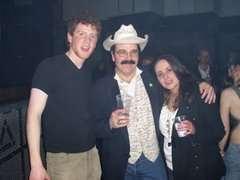
I was going to wear an orange “Guantanamo Bay” jumpsuit, but decided this would prove too embarrassing to those who were accompanying me to the Awards show. Instead, I opted for a tuxedo, white tuxedo shirt and black bow tie, accented with my special “autographed by musicians I have met” cream coloured vest with a matching western Stetson hat and black western boots with silver toe and heel guards. Such an outfit would not be unusual at the Country Music Awards in the United States, but it attracted a lot of attention at the Brits.
ITV was filming me at the pre-party and after the show, women were coming up to me and posing for pictures, giving me their phone numbers and some even asked to take pictures of my boots. One would think the British had never seen anyone dressed this way before by the reactions I experienced throughout the evening. I must say I had a whale of a night being the centre of attention even in the presence of numerous well known rock stars and other luminaries.
The Awards show itself was also quite a memorable experience. It was being broadcast live on ITV for the first time in 16 years, so there were breaks throughout for commercials, which the audience used to refuel and refresh themselves without missing any performers. For those of you who weren’t able to watch the show, I will recap the performances I saw..
The Scissor Sisters opened with their nominated song and a very theatrical performance that simulated them floating around the stage. Muse received the first award of the evening which was then followed by a great performance by Snow Patrol of their nominated song. Awards were then given to the Fratellies, who didn’t seem to want to leave the stage, and to Orson.
Amy Winehouse then came on and performed one of the songs from her “Back to Black” nominated album, but she appeared to be a bit off the mark and under the influence of the “Jack and Coke” she had demanded be available for her party of 20 guests. Amy is such a talented performer, but I’m afraid she is going to end up in rehab like Robbie Williams or killing herself, hopefully the former rather than the latter.
Awards were then presented to James Morrison and Justin Timberlake (the only musician not present to receive his award) and this was followed by a smashing performance by the Killers of a cut from their “Sam’s Town” release. Amy Winehouse received an award and was noticeably “under the influence” during the course of her brief acceptance speech.
Then Nelly Furtado got the nod as best International female artist in a surprise win over Pink based on the crowd reaction. This was followed by crowd pleasing performance of “Patience” by former boy band Take That, who later collected an award for the same song as best British single of the year.
My favs, the Red Hot Chili Peppers, performed just before the Killers picked up an International award for “Sam’s Town” and this was followed by an awesome performance by Colleen Bailey Rae of her nominated song and then the best British single award was presented to Take That.
Artic Monkeys then picked up the best British album award, prior to the lifetime achievement award being given to Oasis as the nights final award presentation. Oasis then closed the show with a live mini-concert of four songs, two new and two old hits, lasting about 25 minutes and running well past the end of the live TV broadcast.
In my opinion, the Brits are a much livelier and entertaining music awards show than their American counterpart, the Grammy’s, which gave nominations and awards to many of the same artists. The Grammy’s come off as a much more tedious and heavily scripted show and the performers and presenters don’t appear to have as much fun as they do at the Brits.
Russell Brand started off slowly as the MC with some of his scripted remarks falling flat at the beginning of the show. But he got better as the evening wore on and he began to ad-lib more and depart from the script in his interactions with the various awards presenters. Russell is at his best in this type of format (when he is un-scripted and running at the mouth) and he was in top form by the end of the evening.
After rubbing elbows with the musical artists present for the awards show, my entourage departed Earls Court for some late night dancing and music at the Elks Club on Broadway and Fulham, before being chauffeured back to our hotel in Kensington. We finished our evening at the hotel bar mixing and mingling with other Brit Awards guests until around 4am in the morning.
Few of us made it to breakfast the next morning but, thanks to our able chauffer, we all made it to the airport in time for our return flight to Dublin that afternoon. All in all, my trip to the Brit Awards was an experience I will never forget or regret. Until next week, what can I say but that the Brits are a great music awards show and “Rock On”. I hope I will be able to attend again someday!
Published April 12th 2007 in Metro Eireann
By Charles Laffiteau
On Valentines Day I had the opportunity to travel to London for the Brit Awards. I will now take some time now to describe my experiences at the night’s events and share my impressions about them with you.
As to why I was attending the Brit Awards, I was fortunate enough to win an all expense paid VIP package which included tickets to the Brits and the pre and post parties, round trip airline tickets, accommodations at a four star hotel in Kensington and a chauffer for my entire stay in London. Usually when I go to London, I go to an ATM at Heathrow, get £50-100 and buy a 3 day off-peak tube and bus pass for £19 so I can get around the city. To be chauffeured everywhere in London was quite a treat all by itself, not to mention the feeling that I was experiencing what it must be like to “live like a rock star”.
Since tickets for the Brits are not sold to the public, the only way to attend the Awards show is to be or know someone in the music industry, or buy them at exorbitant prices from ticket brokers. I was indeed lucky to be able to attend at all, much less to experience the rock star treatment as well.
I was going to wear an orange “Guantanamo Bay” jumpsuit, but decided this would prove too embarrassing to those who were accompanying me to the Awards show. Instead, I opted for a tuxedo, white tuxedo shirt and black bow tie, accented with my special “autographed by musicians I have met” cream coloured vest with a matching western Stetson hat and black western boots with silver toe and heel guards. Such an outfit would not be unusual at the Country Music Awards in the United States, but it attracted a lot of attention at the Brits.
ITV was filming me at the pre-party and after the show, women were coming up to me and posing for pictures, giving me their phone numbers and some even asked to take pictures of my boots. One would think the British had never seen anyone dressed this way before by the reactions I experienced throughout the evening. I must say I had a whale of a night being the centre of attention even in the presence of numerous well known rock stars and other luminaries.
The Awards show itself was also quite a memorable experience. It was being broadcast live on ITV for the first time in 16 years, so there were breaks throughout for commercials, which the audience used to refuel and refresh themselves without missing any performers. For those of you who weren’t able to watch the show, I will recap the performances I saw..
The Scissor Sisters opened with their nominated song and a very theatrical performance that simulated them floating around the stage. Muse received the first award of the evening which was then followed by a great performance by Snow Patrol of their nominated song. Awards were then given to the Fratellies, who didn’t seem to want to leave the stage, and to Orson.
Amy Winehouse then came on and performed one of the songs from her “Back to Black” nominated album, but she appeared to be a bit off the mark and under the influence of the “Jack and Coke” she had demanded be available for her party of 20 guests. Amy is such a talented performer, but I’m afraid she is going to end up in rehab like Robbie Williams or killing herself, hopefully the former rather than the latter.
Awards were then presented to James Morrison and Justin Timberlake (the only musician not present to receive his award) and this was followed by a smashing performance by the Killers of a cut from their “Sam’s Town” release. Amy Winehouse received an award and was noticeably “under the influence” during the course of her brief acceptance speech.
Then Nelly Furtado got the nod as best International female artist in a surprise win over Pink based on the crowd reaction. This was followed by crowd pleasing performance of “Patience” by former boy band Take That, who later collected an award for the same song as best British single of the year.
My favs, the Red Hot Chili Peppers, performed just before the Killers picked up an International award for “Sam’s Town” and this was followed by an awesome performance by Colleen Bailey Rae of her nominated song and then the best British single award was presented to Take That.
Artic Monkeys then picked up the best British album award, prior to the lifetime achievement award being given to Oasis as the nights final award presentation. Oasis then closed the show with a live mini-concert of four songs, two new and two old hits, lasting about 25 minutes and running well past the end of the live TV broadcast.
In my opinion, the Brits are a much livelier and entertaining music awards show than their American counterpart, the Grammy’s, which gave nominations and awards to many of the same artists. The Grammy’s come off as a much more tedious and heavily scripted show and the performers and presenters don’t appear to have as much fun as they do at the Brits.
Russell Brand started off slowly as the MC with some of his scripted remarks falling flat at the beginning of the show. But he got better as the evening wore on and he began to ad-lib more and depart from the script in his interactions with the various awards presenters. Russell is at his best in this type of format (when he is un-scripted and running at the mouth) and he was in top form by the end of the evening.
After rubbing elbows with the musical artists present for the awards show, my entourage departed Earls Court for some late night dancing and music at the Elks Club on Broadway and Fulham, before being chauffeured back to our hotel in Kensington. We finished our evening at the hotel bar mixing and mingling with other Brit Awards guests until around 4am in the morning.
Few of us made it to breakfast the next morning but, thanks to our able chauffer, we all made it to the airport in time for our return flight to Dublin that afternoon. All in all, my trip to the Brit Awards was an experience I will never forget or regret. Until next week, what can I say but that the Brits are a great music awards show and “Rock On”. I hope I will be able to attend again someday!
Barack Obama and the Iraq War
Republican Politics, American Style
Published April 5th 2007 in Metro Eireann
By Charles Laffiteau
Some Democratic Presidential candidates have recently attempted to blur the differences between their positions on the Iraq war and the long held positions of Senator Obama regarding this war. Most Americans, including many Republicans, would not have voted to authorize President Bush to go to war in Iraq if they had known in 2002, what they know today.(ie there were no WMDs or Al Qaeda terrorists operating in Iraq.) Personally, I don't think Senator Clinton and Senator Edwards have to apologize for being duped by the Bush Administration because most Americans were as well.
The distinction between Senator Obama's position and those of the other candidates, is that he opposed the war at a time when it was politically UNPOPULAR to be against it. He did so knowing that taking such a position would probably hurt his chances to be elected to the US Senate in 2004. The other candidates went along with POPULAR opinion at that time, which strongly favoured going to war. Voting to authorize the President to go to war was hardly a politically risky move on their part, but opposing the war was a risky move by Senator Obama.
I don't think any less of Senators' Clinton or Edwards because they went along with popular opinion at the time by voting for the war in Iraq, but I do admire Senator Obama for his willingness to take a principled and UNPOPULAR stand against going to war back in 2002.
Obama’s Democratic opponent’s comments that their positions are all really the same, are an attempt to blur this distinction between the candidates' records regarding the Iraq war and put everyone on an equal footing in terms of opposing it today.
The fact remains however, that Senator Obama's opposition to the war in 2002, though unpopular at the time, has proven to be the right position. It was a position the other candidates wish they would have taken at the time but did not. Senator Clinton and the other candidates need to just concede this point to Senator Obama and move on to other issues.
Real leadership isn't about going along with the conventional wisdom or popular opinion. It's not about blurring distinctions between right and wrong to justify your mistakes or to avoid accountability for them. It's about standing up for what you believe is right and opposing what you think is wrong regardless of the consequences.
Senator Obama has not only been against the war since 2002, but he also demonstrated clarity and insight when he explained why he was against it. At an anti-war rally in Chicago in 2002 he said; "I am not opposed to all wars. I'm opposed to dumb wars. You want a fight, President Bush? Let's finish the fight with Bin Laden and al-Qaeda, through effective, coordinated intelligence, and a shutting down of the financial networks that support terrorism, and with a homeland security program that involves more than colour-coded warnings."
Instead of focusing on co-ordinating intelligence gathering with other countries and hunting down the remnants of al-Qaeda and their Taliban allies in Afghanistan and the border region of Pakistan, the Bush Administration decided to open up a new front in a country with no al-Qaeda terrorists but (unlike Afghanistan) one possessing plenty of oil reserves.
The Bush Administration largely justified its invasion by citing evidence of WMD and visits to Iraq by a Jordanian named al-Zarqawi (who they claimed was a leader of al-Qaeda)along with a mis-guided neo-conservative vision of spreading American style democracy throughout the Middle East.
In fact, al-Zarqawi only became the self-proclaimed leader of al-Qaeda in Iraq AFTER the US invasion. Prior to the invasion he had been fighting Kurdish nationalists as a member of Ansar al-Islam (not al-Qaeda).
Al-Qaeda now has a strong presence in Iraq (which it did not have prior to the invasion) and has used the time since the Iraq invasion to strengthen its alliance with the Taliban in Afghanistan and open new terrorist training camps there and in Pakistan. Furthermore, the Bush Administration's evidence of WMD was at best flimsy and has since been proven to be false and to some extent "manufactured".
As for spreading our vision of democracy throughout the Middle East, is that really a legitimate justification for going to war and spending vast sums of money and American lives in the bargain?
Senator Obama was not alone with his UNPOPULAR view of the Bush Administration's rationale for invading Iraq. 23 other Senators shared some of these same concerns and voted accordingly. Critics who point to the fact that Obama was not a Senator and could not vote against the resolution to authorize the President to go to war are trying to blur the distinction between those who opposed the war from the outset and those who now realize that voting for it was a mistake.
No evidence exists to support the idea that Obama might have changed his anti-Iraq war stance and voted with the majority of 77 other Senators (including Clinton and Edwards) had he been in office as a Senator in 2002.
Senator Obama also demonstrated excellent insight when he expressed his concerns about Sunni and Shiite sectarian violence as another of his reasons for opposing the Iraq war back in 2002.This same concern was one of the main reasons why Bush's father did not invade Iraq during the Gulf War in a 1991. Unfortunately President Bush and his inner circle chose to ignore these concerns. Other Senators who voted against the war cited similar concerns about sectarian conflict in a post-war Iraq as well as their concern that an Iraq war would divert resources from the real "war on terror".
Senator Obama and the other members of Congress who voted against the war should be applauded for their prescience as well the political courage they demonstrated by opposing the war. Attempts by those who were not as forward looking or politically courageous to blur these distinctions should be seen for what they are. Their motives are politically self-serving, because today, being against the war is in line with American POPULAR opinion.
Published April 5th 2007 in Metro Eireann
By Charles Laffiteau
Some Democratic Presidential candidates have recently attempted to blur the differences between their positions on the Iraq war and the long held positions of Senator Obama regarding this war. Most Americans, including many Republicans, would not have voted to authorize President Bush to go to war in Iraq if they had known in 2002, what they know today.(ie there were no WMDs or Al Qaeda terrorists operating in Iraq.) Personally, I don't think Senator Clinton and Senator Edwards have to apologize for being duped by the Bush Administration because most Americans were as well.
The distinction between Senator Obama's position and those of the other candidates, is that he opposed the war at a time when it was politically UNPOPULAR to be against it. He did so knowing that taking such a position would probably hurt his chances to be elected to the US Senate in 2004. The other candidates went along with POPULAR opinion at that time, which strongly favoured going to war. Voting to authorize the President to go to war was hardly a politically risky move on their part, but opposing the war was a risky move by Senator Obama.
I don't think any less of Senators' Clinton or Edwards because they went along with popular opinion at the time by voting for the war in Iraq, but I do admire Senator Obama for his willingness to take a principled and UNPOPULAR stand against going to war back in 2002.
Obama’s Democratic opponent’s comments that their positions are all really the same, are an attempt to blur this distinction between the candidates' records regarding the Iraq war and put everyone on an equal footing in terms of opposing it today.
The fact remains however, that Senator Obama's opposition to the war in 2002, though unpopular at the time, has proven to be the right position. It was a position the other candidates wish they would have taken at the time but did not. Senator Clinton and the other candidates need to just concede this point to Senator Obama and move on to other issues.
Real leadership isn't about going along with the conventional wisdom or popular opinion. It's not about blurring distinctions between right and wrong to justify your mistakes or to avoid accountability for them. It's about standing up for what you believe is right and opposing what you think is wrong regardless of the consequences.
Senator Obama has not only been against the war since 2002, but he also demonstrated clarity and insight when he explained why he was against it. At an anti-war rally in Chicago in 2002 he said; "I am not opposed to all wars. I'm opposed to dumb wars. You want a fight, President Bush? Let's finish the fight with Bin Laden and al-Qaeda, through effective, coordinated intelligence, and a shutting down of the financial networks that support terrorism, and with a homeland security program that involves more than colour-coded warnings."
Instead of focusing on co-ordinating intelligence gathering with other countries and hunting down the remnants of al-Qaeda and their Taliban allies in Afghanistan and the border region of Pakistan, the Bush Administration decided to open up a new front in a country with no al-Qaeda terrorists but (unlike Afghanistan) one possessing plenty of oil reserves.
The Bush Administration largely justified its invasion by citing evidence of WMD and visits to Iraq by a Jordanian named al-Zarqawi (who they claimed was a leader of al-Qaeda)along with a mis-guided neo-conservative vision of spreading American style democracy throughout the Middle East.
In fact, al-Zarqawi only became the self-proclaimed leader of al-Qaeda in Iraq AFTER the US invasion. Prior to the invasion he had been fighting Kurdish nationalists as a member of Ansar al-Islam (not al-Qaeda).
Al-Qaeda now has a strong presence in Iraq (which it did not have prior to the invasion) and has used the time since the Iraq invasion to strengthen its alliance with the Taliban in Afghanistan and open new terrorist training camps there and in Pakistan. Furthermore, the Bush Administration's evidence of WMD was at best flimsy and has since been proven to be false and to some extent "manufactured".
As for spreading our vision of democracy throughout the Middle East, is that really a legitimate justification for going to war and spending vast sums of money and American lives in the bargain?
Senator Obama was not alone with his UNPOPULAR view of the Bush Administration's rationale for invading Iraq. 23 other Senators shared some of these same concerns and voted accordingly. Critics who point to the fact that Obama was not a Senator and could not vote against the resolution to authorize the President to go to war are trying to blur the distinction between those who opposed the war from the outset and those who now realize that voting for it was a mistake.
No evidence exists to support the idea that Obama might have changed his anti-Iraq war stance and voted with the majority of 77 other Senators (including Clinton and Edwards) had he been in office as a Senator in 2002.
Senator Obama also demonstrated excellent insight when he expressed his concerns about Sunni and Shiite sectarian violence as another of his reasons for opposing the Iraq war back in 2002.This same concern was one of the main reasons why Bush's father did not invade Iraq during the Gulf War in a 1991. Unfortunately President Bush and his inner circle chose to ignore these concerns. Other Senators who voted against the war cited similar concerns about sectarian conflict in a post-war Iraq as well as their concern that an Iraq war would divert resources from the real "war on terror".
Senator Obama and the other members of Congress who voted against the war should be applauded for their prescience as well the political courage they demonstrated by opposing the war. Attempts by those who were not as forward looking or politically courageous to blur these distinctions should be seen for what they are. Their motives are politically self-serving, because today, being against the war is in line with American POPULAR opinion.
Subscribe to:
Posts (Atom)